Showing posts with label Youth. Show all posts

Wednesday, March 25, 2026

Essential guide for hikers, hunters, and outdoors people

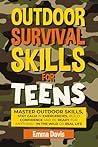
Outdoor Survival Skills For Teens: Master Outdoor Skills, Stay Calm In Emergencies, Build Confidence And Be Ready For Anything—in The Wild Or Real Life (Therapy and Mental Health Books For Teens)Outdoor Survival Skills For Teens: Master Outdoor Skills, Stay Calm In Emergencies, Build Confidence And Be Ready For Anything—in The Wild Or Real Life by Emma Davis
My rating: 5 of 5 stars

Teenagers are full of energy and are always exploring, learning about the world. Some like indoor and technology, while others like to spend time in the great outdoors – hiking in the forests, traversing mountains, camping, etc. These activities are fraught with risks of injury, disease, and even death. It is crucial that anyone intending to explore or spend time outdoors should develop a strong understanding and appreciation of these risks. Learning, training, and practicing the skills learned are essential for survival outdoors.
One way to learn and imbibe these essential traits is by reading Emma Davis’ book titled Outdoor Survival Skills for Teens. Though the 198 page volume is titled and aimed at teens, the knowledge can help people of all ages. Davis, an author with many talents and training including social work, therapy, and financial advice, brings this to join her several books aimed at teenagers. She has written several books on a diverse range of topics including finances, career planning, DBT techniques, among others.
Survival Skills for Teens spans six chapters, preceded by an introduction and followed by an exhaustive reference list. The book teaches readers how to survive in the wilderness, camping skills, and several tips that can be helpful while spending time outdoors. Introducing the book to readers Davis explains that this volume is aimed at teens, adults, and children who not only want to learn how to make a fire, but also how to stay calm if they get lost in the forest. It is for those individuals who want to take calculated risks, be prepared for any eventuality they might face while outside.
My favorite chapter of this book is the one titled “Snack or Poison” in which the author gives a detailed description of foraging while lost in the wilderness. She makes it a point to explain the distinction between edible berries vs poisonous ones, how one can differentiate and prevent catastrophic events. The three tests before you munch section is very useful guide for the first time forager. The box on how poisoning takes effect is very informative too.
Overall I believe the book will prove to be a very useful resource for all those who wish to explore outdoors and be prepared. The information in this volume will not only help teens, but adults alike. I would recommend this book for everyone interested in outdoors, irrespective of age.

View all my reviews

Monday, May 19, 2025

Financial Management Guide For Teens

Essential Money Skills for Ambitious Teens by River Ellington, 152 pp 

Teenagers are at a very important juncture in life – the cusp of adolescence and adulthood. Several lifetime habits, friends, beliefs, practices, etc. are formed at this age. Most teens live with parents, go to school, and hang out with friends, they rarely think of money, savings, etc. Their needs for the most part are taken care of by parents. Despite financial literacy being so vital for a successful, and comfortable life, most of us have had to figure things out via trial and error.

In this scenario comes River Ellington’s latest book on financial literacy, smart saving, and investing titled “Essential Money Skills for Ambitious Teens.” Spanning over 150 pages this book introduces the world of money, savings, investments, and other life skills to teens. Introducing the need for this book Ellington writes: “Most teens don’t think much about money until they don’t have enough of it. Whether it’s wanting the latest shoes, saving for a car, or dreaming about financial independence, money plays a huge role in shaping the life you want. Yet, schools rarely teach real-world financial skills, leaving many young adults to figure things out through trial and error.”

Divided into nine easy to read chapters, the book also gives some bonus information and benefits including: a. Teen money toolkit; b. Side hustle starter pack; c. Money mindset makeover workbook; and d. Scam safe teen cheat sheet. These digital resources are free and beneficial for the teens starting their journey into adult life of earning money, paying bills and managing finances.

Essential Money Skills for Ambitious Teens lists eight habits – a chapter dedicated to each that would transform a naïve teen into a financial savvy young adult. Starting off with a chapter on “Shift your money mindset,” the book delves into “Pay yourself first,” followed by sections on budgeting and spending wisely, aligning with values, monetizing skills, among others. Concluding with a two page epilogue the book reinstates the eight habits of financial savvy children and provides a 3-year plan to implement the habits and strategies in this book.

I think this book is a must read for teenagers heading to college, being out of the security of home first time in their lives, as also to parents of teenagers, and anyone that is starting out on their financial independence journey.

Tuesday, August 16, 2011

Zindagi Na Milegi Dobara - Movie Review

zindagi-na-milegi-dobara-poster - Bollywood World

I watched this movie when I was in India recently. The movie is for the young and young-at-heart viewers who like the feel-good themes that bollywood throws up sometimes. The movie centers around three heroes Arjun (Hrithik Roshan), Imran (Farhan Akthar), and Kabir (Abhay Deol). Of course there are three heroines too, otherwise it wouldn't be a Indian flick. Anyway the story is all about Kabir's impending marriage and a road trip that the three friends take as part of their bachelor party.

The three friends of course atrociously rich - most middle-class Indian kids would not be able to afford a trip like this - meet up in Spain and start of their adventure sports. Deep sea diving, sky diving and being part of a traditional bull chase festival is what the three intend to do. The movie also exposes the baggage that the friends carry and help resolve issues between the friends and also in their lives.

Imran reconciles to the fact that his biological father is just that, Arjun finds a new girl friend and Kabir understands that marriage is not for him right now.

Summing up I'd say it is definitely worth watching and one of those movies without too much drama and few songs and can be watched with the family.

Sunday, September 20, 2009

Book Review: Sadak Chhaap

Story of a Mumbai street kid
Sadak Chhaap by Meher Pestonji; Penguin Books; Price: Rs.250; 190 pp.

According to an Amnesty International report (1999), 18 million children eke out a hazardous existence on the mean streets of India’s ill-planned, under-served cities where 40-60 percent of the population live in squalid slums. With railway platforms, bus stations and other public spaces serving as their homes, doing odd jobs, scavenging rubbish dumps and begging, they are easy prey to paedophiles, gangsters, unscrupulous businessmen and drug and substance dealers. With no education, skills or training these children have to fend for themselves in an environment in which even the beat policeman is usually a predator.

Sadak Chhaap (‘Mark of the Street’) is a work of fiction based on the lives of street children in Mumbai. Its protagonist is ten years old. Rahul a typical street kid living on a railway platform. A sprightly lad, he has run away from a village which he himself doesn’t remember. But unlike his peers who are resigned to life on the street Rahul is determined to rise up and move out.

The main characters of the book are an eclectic mix of people ranging from Karim Bhai (a fruit stall owner and father figure), Bablu (his best friend, also a street kid), Aparna (who works at Sharan — a shelter for street children), Chameli (a flower seller on whom Rahul has a secret crush) and baby Kajol. There are other characters in supportive roles including street children Victor and Shekar, vendors Hamid, Heera etc, who are not quite fleshed out, but are important to complete the plot of the narrative.

Written by Meher Pestonji, a freelance journalist and social worker, whose earlier works include Mixed Marriage and Other Parsi Stories, Pervez: A Novel, and Piano for Sale, a play, Sadak Chhaap is the outcome of her voluntary work with street children in Mumbai. The narrative begins on a railway platform, where Rahul, feasting on a stolen mango spots a small package on a neighbouring bench. In the hope of chancing upon some food, clothes or a blanket, he opens the package to discover a half-burnt baby with ants crawling all over her face. He runs to Sharan and approaches Aparna who heads the shelter, to rescue the child.

The child is taken to hospital for treatment and is saved in the nick of time. Rahul christens her Kajol after his favourite Bollywood movie star. Soon Kajol is moved to an orphanage in Vashi, a distant suburb of Mumbai and in appreciation of his good turn, Rahul is offered the job of a gardener in the orphanage. He seems to be moving up in life, but typically the management of the institution demands a stiff price in terms of total obedience and conformity. For the small misdemeanour of sneaking out to watch a movie and meeting his old friends on the street, he is found out and sacked from his job. Kajol is given away in adoption and Rahul is denied the privilege of meeting with her.

Without shelter and jobless again, Rahul shifts base to the streets near the Gateway of India which offer new challenges. To survive on these mean streets he begins running drugs and becomes a male prostitute at the age of twelve. On one such sexual assignment Rahul is badly abused by a firang (foreign) sexual pervert, Greg. This traumatic experience plunges him into further despair for which drugs are the only pain killers. But his friends at Sharan rescue him and enroll him for detox sessions.

Pestonji weaves a fast-paced and absorbing narrative which is a window looking out on the brutal streets of Mumbai, where millions of impoverished children are left to fend for themselves. Living in the shadows of the city’s plush 5-star hotels where gastronomic excess and effete luxury are a way of life, for these Fagin’s children hunger is a constant companion. Rahul steals a bicycle to save bus fare; lies to keep Kajol within reach and eventually succumbs to the lure of affectionate paedophiles. Pestonji’s vocab and descriptive power highlights the despair of these helpless children and her portrayal of street life has the stamp of authenticity. Moreover the direct, simple and sensitive plot into which her social message is woven, makes compelling reading.

Sadak Chhaap is a simply told tale whose subtext is a campaign against the neglect and abuse of India’s huge population of street children. But its major infirmity is that it is recounted as a breathless narrative of episodes and adventures in quick succession. There is a conspicuous dearth of analysis of the causative factors proliferation of street children. Surely Aparna who heads the NGO Sharan would have some macro level explanation? To accept the status quo as the natural order of things is suggestive of excessive pessimism if not a morality. Moreover Pestonji seems oblivious of the reality that some street children have — with a little help from NGOs and social workers — risen from the streets and gone on great things. A note of optimism could have retrieve the gloom which pervades the novel.

Also towards the end, Pestonji seems to lose the thread of the narrative and veers into a denunciation of communalism, making a passing reference to the Gujarat riots of 2002. This is a rather unnecessary inclusion and strikes a jarring chord which is out of sync with the major issues the novel confronts — homelessness, drug addiction, child marriage and sex tourism.
Reblog this post [with Zemanta]